What Happens in Your First CBT Therapy Session? A Guide to Starting Therapy

Updated: Jul 31
If you've ever found yourself wondering, "What actually happens in a first CBT therapy session?" you're certainly not alone.
One of the most common questions people ask me before booking is exactly that.
Sometimes it's asked directly. Other times it's hidden inside another question:
"What if I don't know what to say?"
"Do I need to prepare?"
"Will you ask me loads of difficult questions?"
"What if I get upset?"
"What if my problems don't sound 'bad enough'?"
If any of those thoughts sound familiar, you're in good company.
Starting therapy can feel a little like turning up to your first day somewhere new. You know it's probably going to be helpful, but not knowing what to expect can leave your mind filling in the blanks - and our minds aren't always known for choosing the most reassuring storyline.
So let's take away some of that uncertainty and walk through what usually happens during a first CBT therapy session.
Why the First Session Is Different
The first appointment is a little different from the therapy sessions that follow.
Rather than jumping straight into techniques or homework, the first session is about understanding you.
Think of it like using a sat nav. If you don't know where you're starting from, it's difficult to work out the best route forwards.
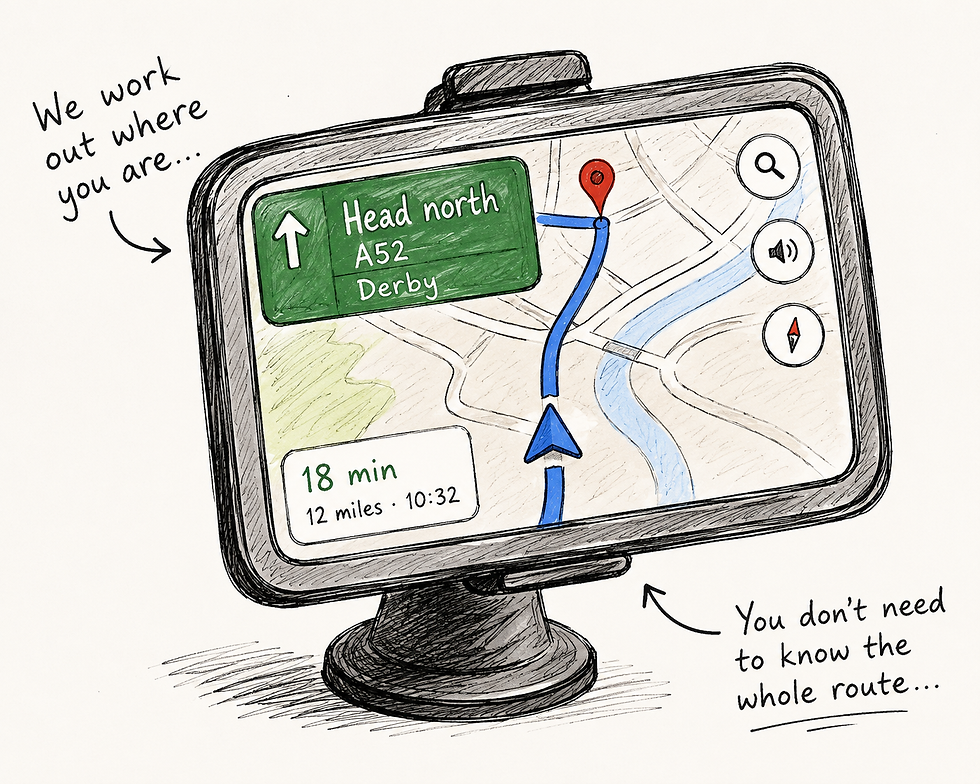
That first appointment gives us the opportunity to slow things down, understand what's been happening and begin making sense of why things feel the way they do.
There's no expectation that you'll arrive with everything neatly organised.
You don't need a timeline.
You don't need the "right" words.
You don't need to have worked out what's wrong.
Many people apologise for "rambling" in their first session.
The truth is, most people don't tell their story in a perfectly organised way - and that's absolutely okay. My job isn't to judge how you tell it; it's to help make sense of it alongside you.
It's Less About Being Interviewed... and More About Being Understood
Some people imagine their assessment will feel like sitting an exam.
In reality, it tends to feel much more like a conversation.
We'll explore things like:
What's brought you to therapy now
What you've been finding difficult
When you first noticed these difficulties
What you've already tried
How things are affecting your daily life
What you'd like life to look like if therapy were helpful
There aren't any right or wrong answers.
Sometimes people know exactly what they want help with.
Sometimes they don't.
Both are completely okay.
One of the most valuable parts of the first session is that we begin putting words to experiences that may have felt confusing for a long time.
Many people tell me they've never actually said some of these things out loud before.
Looking Beyond Symptoms
One of the things I love about CBT is that it isn't just about asking, "What's wrong?"
Instead, it's about asking:
"What makes sense about what's happening?"
That means we look at the bigger picture.
We'll explore things like:
Important life experiences
Relationships
Work or study
Physical health
Current stresses
Things that already help
Your strengths (even if you struggle to see them yourself)
Imagine meeting someone halfway through a film.
You'd probably understand what was happening in that particular scene, but you'd miss all the context that explains why.
Our minds work in a similar way.
When we understand the context, thoughts, emotions and behaviours often begin to make much more sense.
Making Sense of Your Mind
One thing I hear surprisingly often is:
"I know it doesn't make sense... but I still feel this way."
The good news?
Feelings don't need to seem logical to be understandable.
One of the things CBT does really well is helping us understand the links between:
Thoughts
Emotions
Physical sensations
Behaviours
Rather than looking at each separately, we begin to see how they influence one another.
For example, imagine your brain has a smoke alarm that's become particularly sensitive.
It isn't broken.
It's trying to protect you.
The difficulty is that it may now be going off when someone burns the toast rather than when there's a real fire.
Anxiety often works like that.
The alarm isn't the problem.
The question becomes:
"Why has it learnt to respond this way?"
Once we understand that, we can begin helping it respond differently.
Do I Have to Talk About Everything?
This is probably one of the biggest worries people have.
The short answer is:
No.
You never have to share more than you feel ready to.
If you've experienced difficult or traumatic events, many people worry therapy means
having to describe everything in detail straight away.
That isn't how I work.
Being trauma-informed means recognising that your brain and body have often been trying to protect you.
Therapy isn't about forcing those protective strategies away before you've built enough understanding and confidence.
Instead, we work collaboratively, at a pace that feels manageable.
Sometimes understanding what's happening in the present is the best place to begin.
If you'd like to read more about this, I've written another blog explaining what actually happens in trauma-informed CBT therapy and why it may feel different from what you expect.
Agreeing a Plan Together
By the end of your assessment, we usually have a much clearer picture of what's been happening.
We'll talk together about:
What seems to be keeping the difficulties going
What your goals are
Whether CBT feels like the right approach
How we might begin working towards the changes you'd like to make
One of the things I value most is collaboration.
You are the expert on your life.
My role is to bring psychological knowledge, curiosity and evidence-based tools that help us understand it together.
We're not trying to "fix" you.
We're trying to understand patterns that may no longer be serving you.
What Happens After the Assessment?
If we decide to work together, future sessions become much more focused.
We'll begin exploring the patterns we've identified and gently testing out new ways of responding.
Sometimes that involves noticing thoughts differently.
Sometimes it's changing behaviours.
Sometimes it's learning to respond to difficult emotions with a little more compassion.
Think of it like learning a new dance.
At first, your brain naturally wants to go back to the steps it's practised hundreds or thousands of times before.
That doesn't mean you're failing.
It simply means your brain is doing what brains do - repeating what's familiar.
Therapy gives you the chance to practise different steps until they begin to feel more natural.
You Don't Need to Have It All Figured Out
If you're reading this because you're thinking about starting therapy, perhaps the biggest thing I'd like you to know is this:
You don't need to arrive knowing exactly what's wrong.
You don't need to explain everything perfectly.
You don't need to have the "right" words.
Many people worry they'll cry.
Some worry they won't.
Some are afraid they'll forget everything they wanted to say.
Others worry they'll talk too much.
All of those experiences are far more common than you might imagine.
Your first therapy session isn't about getting everything right.
It's about beginning to make sense of things together.
And sometimes, that's the first moment in a long time that people realise their experiences aren't random, irrational or signs that they're broken.
Often, they make far more sense than they first believed.
Thinking About Starting CBT?
If you're considering therapy and wondering whether CBT might be the right fit, I offer a free 15-minute consultation. It's an opportunity to ask any questions you have, talk about what you're looking for, and see whether working together feels like the right fit -
without any obligation to book.
I offer online CBT for adults across the UK and internationally, as well as in-person therapy in Derby. Whatever you're seeking support for my aim is to help you make sense of what's been happening with compassion, curiosity and evidence-based CBT.
You don't need to have everything figured out before reaching out. Sometimes the hardest part is simply taking that first step.
Frequently Asked Questions
How long is the first CBT session?
My initial assessment lasts 60 minutes, giving us enough time to understand what's brought you to therapy and begin making sense of the bigger picture. Ongoing therapy sessions are usually 50 minutes.
Do I need to prepare before my first session?
Not at all. You don't need to make notes, remember everything or know exactly what to say. Many people worry they'll forget something important or won't explain things "properly". My role is to help make sense of things with you, not to expect you to have all the answers.
Will I have to talk about traumatic experiences?
No. You are never expected to share more than feels manageable. Trauma-informed CBT works collaboratively and at a pace that feels right for you. We focus on understanding your experiences and helping your nervous system feel safe enough to move forward, rather than forcing you to revisit difficult memories before you're ready.
What if I get emotional?
That's completely okay. Therapy is one of the few places where you don't have to pretend you're coping. Some people cry, some laugh, some feel nervous, and some aren't sure how they feel at all. There's no "right" way to be in therapy.
What if CBT isn't right for me?
We'll discuss this openly during the assessment. If another approach seems more appropriate, we'll talk about that too.
📝 Making Therapy Make Sense
At CBT with Jo, I believe that people make sense. Our thoughts, emotions and behaviours often develop for understandable reasons, even when they no longer feel helpful. My aim is to help you make sense of what's been happening with compassion, curiosity and evidence-based CBT - so that change feels possible, not overwhelming.
✨ You don't need to have everything figured out before starting therapy. Sometimes the first step isn't having the answers - it's having someone to help you make sense of the questions.

Comments