Why It’s So Hard to Ask for Help (Even When You’re Struggling)

“I should be able to cope with this.”
It’s a thought I hear a lot.
Sometimes it’s said out loud. More often, it sits quietly in the background while someone carries on with work, looks after their family, answers messages, gets through the day and tells themselves they just need to try a little harder.
Because surely, if you’re still functioning, you must be coping?
And if other people have it worse, perhaps you don’t really have a reason to ask for help.
But there’s a difference between coping and coping well.
You can be functioning on the outside while struggling enormously on the inside.
You can keep going and still be exhausted.
You can be getting everything done and still feel overwhelmed.
You can be the person everyone relies on and still quietly wonder how much longer you can keep doing it.
And sometimes, the belief that “I should be able to cope with this” becomes one of the biggest barriers to getting support.
“It’s not bad enough.”
One of the most common reasons people delay seeking therapy is the belief that their difficulties aren't serious enough.
They might think:
“Other people have been through much worse.” “I’m still going to work.” “I’m managing.” “I should be able to sort this out myself.” “I don't want to waste anyone’s time.”
There can be an invisible threshold in our minds - a point where we believe we become “struggling enough” to deserve support.
But there isn't a universal threshold.
You don't have to wait until you're unable to function before your difficulties matter.
Many people seek therapy precisely because they don't want things to get to that point.
“I should be stronger than this.”
Sometimes the barrier isn't about whether the problem is serious enough.
It's about what struggling seems to say about us.
If you've always seen yourself as capable, independent or resilient, needing help can feel strangely uncomfortable.
You might think:
“I normally cope with everything.” “I'm the strong one.” “I shouldn't be this affected by it.” “Why can't I just get on with things?”
There can be a hidden rule underneath this:
Strong people cope. Capable people manage. If I need help, perhaps I'm not either of those things.
But needing support doesn't cancel out your strength.
Sometimes strength has become so closely associated with carrying everything yourself that putting something down feels like failure.
“I don't want to be a burden.”
For some people, asking for help brings up a different fear.
Not “am I struggling enough?” But: “am I allowed to need something from someone else?”
Perhaps you've become very good at considering other people's needs.
You say yes when you'd rather say no. You minimise how you're feeling. You don't want to make a fuss. You tell people you're fine because explaining what's actually going on feels like too much.
So when the thought of reaching out for therapy comes up, it can feel uncomfortable.
What if I'm taking up someone's time? What if someone thinks I'm being dramatic? What if my problems aren't important enough?
When you're used to putting your own needs last, recognising that you need support yourself can be surprisingly difficult.
“I've always just got on with it.”
Some people don't consciously decide not to ask for help. They simply don't know how.
They've spent years responding to difficult situations by pushing through, staying busy, keeping control or putting their feelings to one side.
Perhaps that was what was needed at the time. Perhaps there wasn't much space to stop and think about how you were feeling. Perhaps you learned that emotions were something to get through rather than something to understand.
From a trauma-informed perspective, it can be useful to understand these patterns with curiosity rather than judgement.
Becoming highly independent, staying in control or learning not to rely on other people can sometimes be an understandable response to what you've experienced.
But something that once helped you cope doesn't necessarily have to be how you cope forever.
And asking for support can feel very unfamiliar when you've spent a long time doing everything yourself.
“But I am coping.”
And perhaps you are.
Therapy isn't about convincing you that you can't cope.
There are situations in life that are genuinely difficult, and sometimes you're doing the best you can in circumstances that are asking a lot of you.
The question isn't always:
“Can I cope?”
Sometimes it's:
“What is it costing me to cope in this way?”
Maybe you're getting through work but spending your evenings completely drained. Maybe you're functioning during the day but lying awake replaying conversations at night. Maybe you're managing everything for everyone else but have very little idea what you actually need.
That's still coping.
But it doesn't necessarily mean you're okay.
Why It’s So Hard to Ask for Help?
Many people don’t reach out because coping has become something they feel they should be able to do alone. Understanding why it’s so hard to ask for help can make it easier to recognise when you might need support - and why that’s okay.
When coping starts to feel like carrying a heavier and heavier backpack...
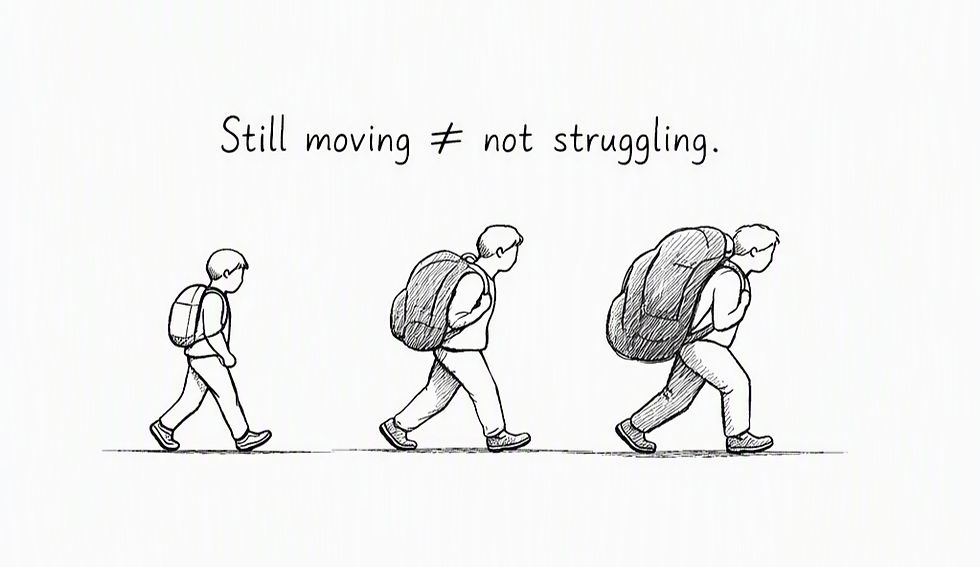
Sometimes coping looks a lot like carrying a backpack.
At first, it’s manageable. You can walk with it, adjust the straps, get on with your day.
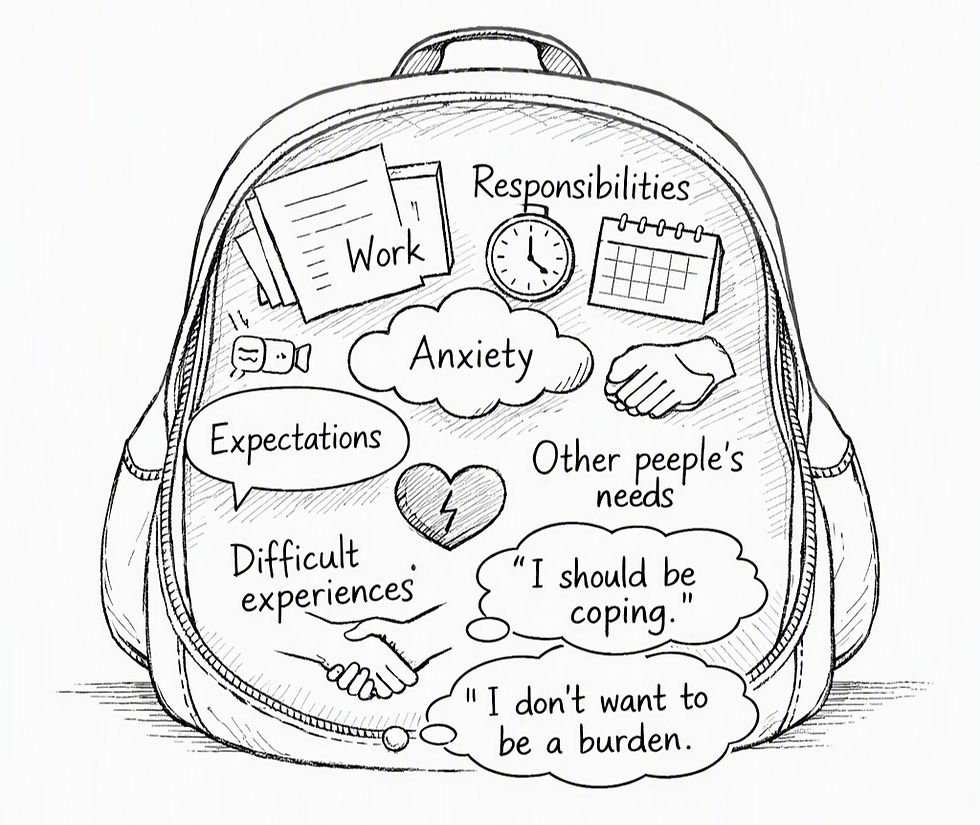
But over time, more and more gets added to it:
Work
Family responsibilities
Anxiety
Expectations
Difficult experiences
Other people’s needs
“I should be coping”
“I don’t want to be a burden”
From the outside, you’re still moving. You’re still functioning. So, it looks like you’re coping.
But the backpack is getting heavier.
And maybe you’ve been carrying it for so long that you’ve stopped noticing the weight - you’ve just adapted, pushed through, kept going.
From a CBT perspective, this is often what happens when the thought “I should be able to cope with this” shows up. You tighten the straps, take a breath, and keep walking. You minimise how heavy it feels. You tell yourself other people carry more. You avoid asking for help because you think you should manage it alone.
But coping by carrying everything yourself doesn’t mean the load isn’t affecting you.
For many people, this is exactly why it’s so hard to ask for help - the load has become normal, familiar, and quietly overwhelming.
And sometimes the most meaningful shift isn’t dropping the backpack completely - it’s simply taking it off for a moment.
Not because you’ve failed. But because carrying it alone isn’t the only option.
You’re allowed to pause. You’re allowed to rest. You’re allowed to ask someone to help you look at what’s inside the backpack and decide what actually needs to be carried - and how.
Still moving ≠ not struggling. Just because you can carry it, doesn’t mean you have to carry it alone.
What if I really should be able to cope?
This is an important question.
Because sometimes the answer isn't to simply challenge the thought and tell yourself, “Of course I don't need to cope.”
Life does involve difficult things. You may be dealing with circumstances that genuinely require you to keep going.
Therapy can't remove every difficult situation, and it doesn't mean you'll never have to cope with hard things again.
Instead, therapy can create space to understand how you're coping, why you're coping that way and whether there might be another way.
It might help you understand patterns you've been stuck in. It might help you become more aware of what you're feeling and needing. It might help you respond differently to thoughts, emotions or situations that currently feel overwhelming.
And sometimes, it might simply give you somewhere to stop for a moment.
Not because you've failed to cope. Because you don't have to spend every minute proving that you can.
Maybe the question isn't whether you should be able to cope.
Try asking yourself:
What does “coping” actually mean to me? If a friend told me they were struggling with the same thing, would I expect them to manage it alone? What am I worried would happen if I admitted I needed help? Am I coping, or am I simply functioning? How long have I been telling myself I should be able to manage this?
And perhaps the most important question:
What would I say to someone I cared about if they were carrying what I'm carrying?
Would you tell them they weren't struggling enough? Would you tell them they were a burden? Would you tell them to wait until things became unbearable?
Probably not.
So perhaps you don't have to hold yourself to a different standard.
You don't have to wait until you can't cope.
Asking for support doesn't have to mean you've reached breaking point.
It doesn't mean you're weak. It doesn't mean you're incapable. And it doesn't mean your problems are “bad enough” to deserve attention.
Sometimes reaching out is simply recognising:
“This is harder than I want it to be, and I don't want to keep doing it this way.”
That's enough.
Therapy can be a space to slow things down, make sense of what's happening and understand the patterns that keep you stuck. It's not about fixing you or telling you how you should feel. It's about working collaboratively to understand what's going on and explore what might help.
You don't have to prove that you're struggling enough before you're allowed to ask for support.
And if you’ve been wondering why it’s so hard to ask for help, therapy can be a space to explore that gently and without judgement.
And maybe the question isn't:
“Should I be able to cope with this?”
Maybe it's:
“Do I really have to carry all of this alone?”
If you've been wondering whether therapy might be helpful, you can book a free 15‑minute consultation with me to talk through what's been going on and whether CBT feels like the right fit for you.
Instagram - @cbtwithjo
Comments